Winter landscape – some experiments

Here are some more images from my recent short course at West Dean College in West Sussex.  We did quite a bit of experiment with ink, using various tools, and with graphite.  Some of this was on the theme of ‘winter landscape’, taking a rather abstract rather than observational approach.  Here are some of the experiments I did.img354 (3)

img358 (2)

Works on paper

img342 (2)

My drawings here are based on drawings by Honore Daumier of French judges (drawn about 1850).  Today I have been drawing in the study room of the Victoria and Albert Museum works on paper collection, which own the Daumier drawings, and many others.  These collections, which also exist at the British Museum, Tate Britain and the Courtauld, are an extraordinary and little known resource.  Members of the public can make appointments to see, and if wished, draw from drawings by world famous artists, free of charge.  So much can be learned from the close observation which comes with copying drawings in different styles.img341 (2)

Drawing in London museums

img336 (2)

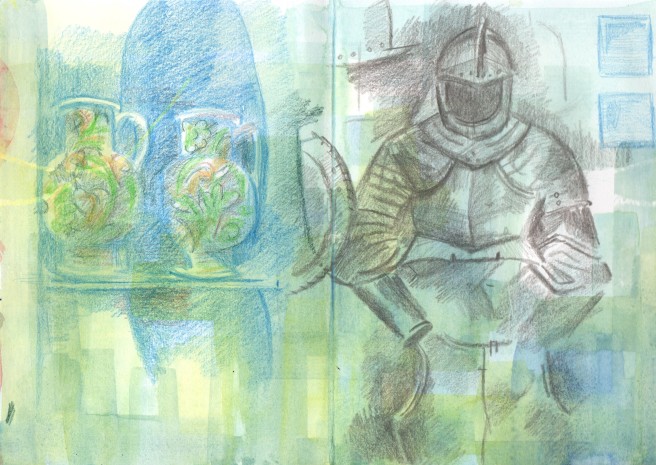
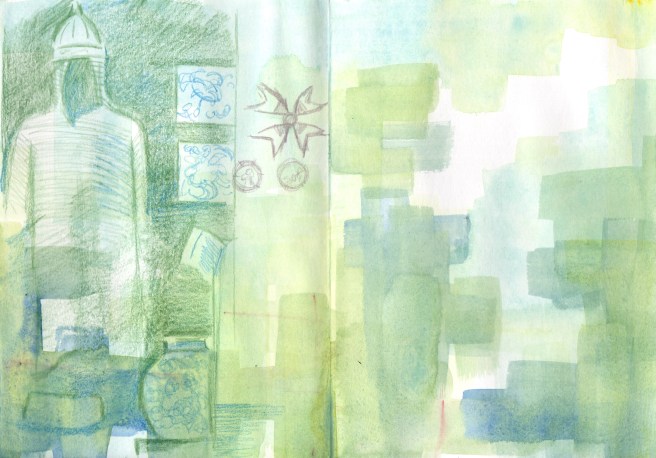
I did the drawing above this week at the Museum of the Order of St John, in Clerkenwell.  The museum tells the history of the Order of St John, established in eleventh century Jerusalem to provide medical care for sick pilgrims, and then acquiring a military role in the crusades.  After a complex history, it is now the St John Ambulance Brigade.  A second drawing, below, shows the process I am using quite a bit at the moment, drawing in coloured pencil onto a pre-prepared background of water colour.

img337 (2)

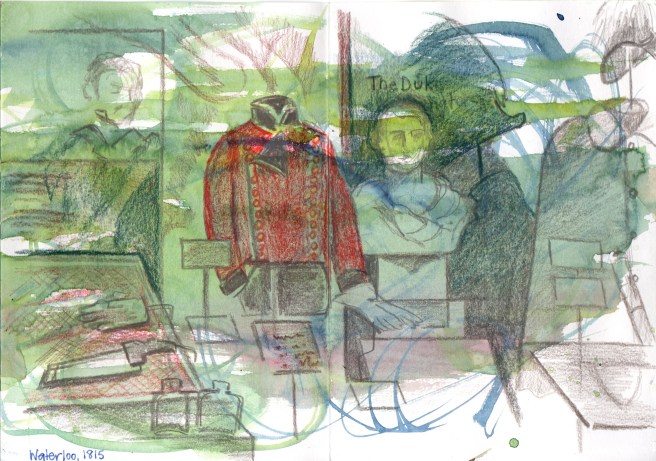
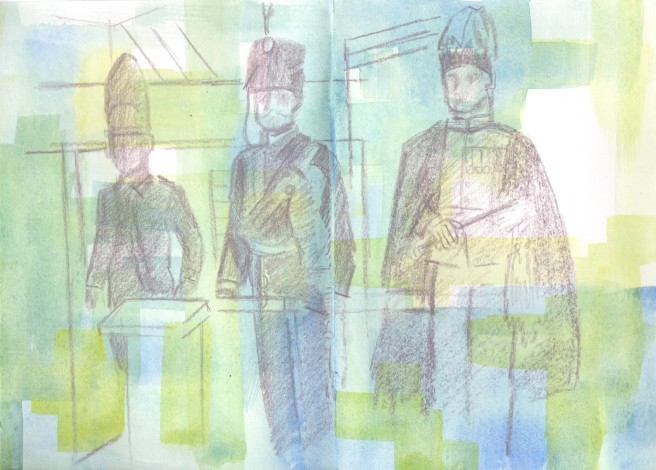
The two drawings below were done at the National Army Museum in Chelsea.  The first is a display related to the battle of Waterloo, the second, a display of historic army uniforms.

img333 (2)img338 (2)

Art of Ancient Egypt

img313 (2)

I have never visited Egypt, but am always interested in seeing the art and artefacts from such an ancient culture.  This composite drawing was done in the Fitzwilliam Museum, Cambridge, as part of a joint meet-up with the London and Cambridge Urban Sketchers groups last Saturday.

In Southern Italy

img317

I have just returned from a painting holiday in Southern Italy, staying in Matera, and in Alberobello in Puglia.  Here are some watercolours from this trip, all painted on location.  Matera is famed for the Sassi cave dwellings which are believed to have been inhabited for 7000 years.  The view of the town, topped by the tower of the cathedral with a river gorge below was certainly challenging.  We then moved on to Alberobello, which is known for the trulli buildings, a traditional form of rural building now a focus of the tourist industry.

img325

From here, we visited Monopoli, Polignano a Mare, and Locorotondo.  Here are some other paintings I made on this trip:

Gardens and buildings

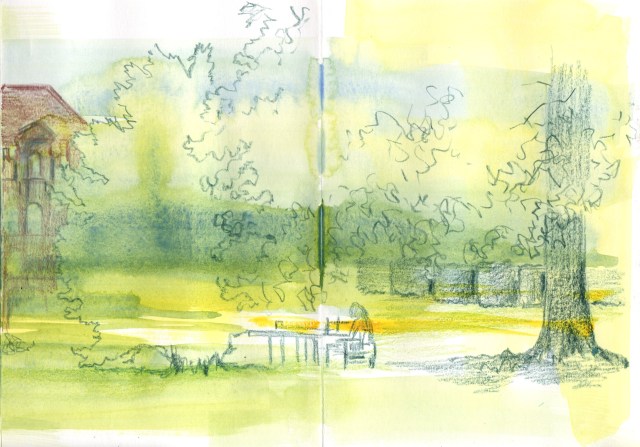
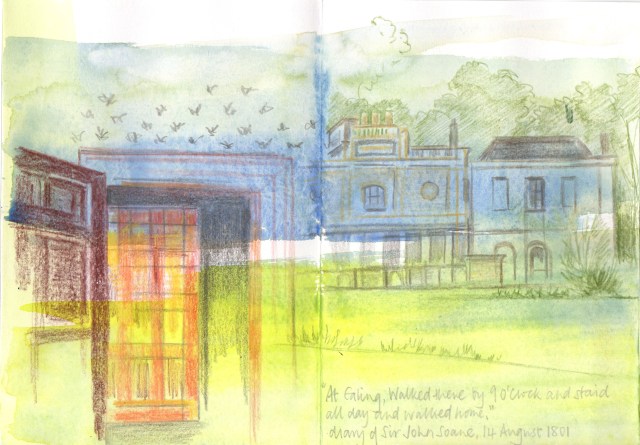
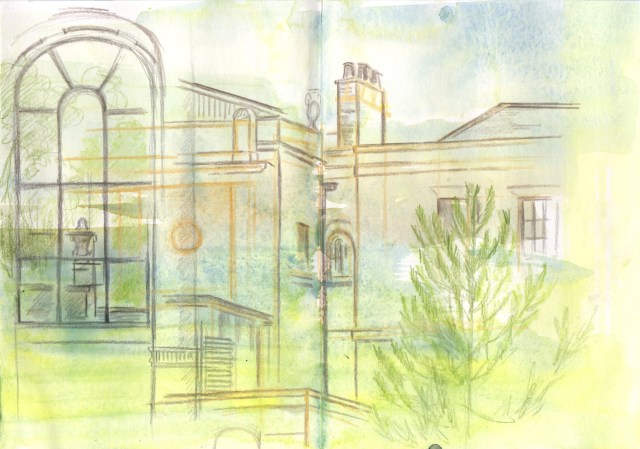
Some more drawings from my sketchbook, in coloured pencil on watercolour backgrounds.  The locations share a theme: a historic building set in gardens.  The first two drawings here – each pair of drawings is actually one continuous image in a concertina sketchbook – were done recently at Newnham College, Cambridge.  The ones below that were done at Pitzhanger Manor in Ealing, West London.  This was the country house of architect Sir John Soane, and I tried to capture some of the characteristics of his architecture, such as the use of coloured glass, and the rounded brick arches.

img310img311

img308img309

Watercolour experiments

This month’s challenge has been to paint some quick watercolour experiments at home.  I wanted to paint in a freer, more expressive way, and also to use some of the kit I have already but rarely use.  I combined the watercolour with watercolour pencils, crayons, salt (for texture), and used different brushes.  I found it easier to do quick experiments at home rather than when I was in front of a location subject which seemed to need a more complex approach.  I ended up painting mostly from flowers I had bought – an advantage was that I have continually had fresh flowers in the house.  Next, I need to take some of this further in more developed pictures.

More urban sketching

img293

This weekend I have been sketching in London.  Above is a drawing I did on Saturday of the ever-changing City skyline, drawn from near Tower Bridge.  It amazes, and sometimes worries me how quickly major developments take place in key areas of London.  A couple of years ago, Norman Foster’s ‘Gherkin’ building on St Mary Ax dominated the view of the ‘new’ City.  Now new buildings have shot up which dwarf it.

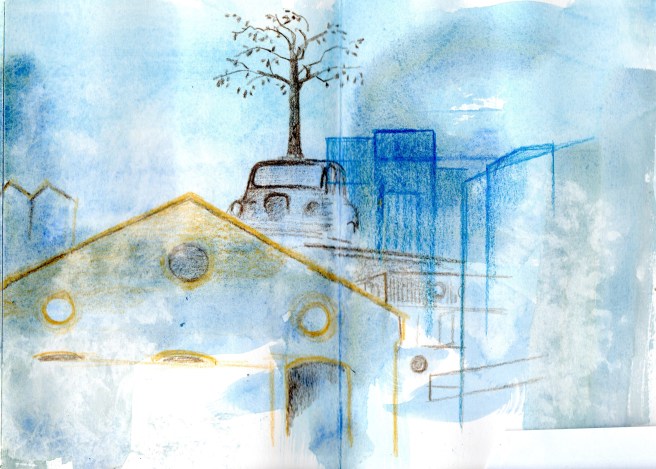
On Sunday, I was helping run a sketch crawl with Urban Sketchers London at Trinity Buoy Wharf.  This is further east, across the Thames from the O2 in North Greenwich (originally the Millennium Dome).  Trinity Buoy Wharf has the only lighthouse in London, surrounded by other older industrial/nautical buildings.  It is now a centre for cultural activities and related businesses, surrounded by very new high-rise housing and offices, with great views of the river.  My sketches take different elements of this and put them together.  All sketches are done with coloured pencil on prepared but random backgrounds in watercolour, on a concertina sketchbook.  Below are the drawings from Trinity Buoy Wharf:

img290img292

Park Life: Nature and the city

Last weekend I joined a workshop run by Pushing Your Sketching Boundaries, taught by Isabel Carmona and Celia Burgos.  We worked out of doors in Hampstead and Highgate in north London.  Our sketches were focussed on two main themes: contrasting the city and nature, using watercolour, and using colour to show tone and depth, using coloured pencils.  Here are some pictures I created.

Day 1: Working on Parliament Hill, one of the highest parts of London, I did several studies which showed a panoramic view of the city through trees, and individual houses framed by trees.

This was quite a challenge, but I learned a lot.  The second and third pictures above had colour washes added later at home – I think the apricot sky helps, and the added blue is overdone.  The warm, apricot sky is not realistic; I added the colour I though the picture needed.  I am not sure why it has taken me such a long time to realise I can do this.  It helps, particularly when a subject is green and more green.

img269 (2)

The painting above I think is better, and benefitted from the experience of doing the others.

Day 2: This looked at using colour, and coloured pencils, to represent tone (light/dark), texture, and depth, in particular the principal that warm colours (reds, oranges, reddish browns) appear to come forward in a painting, and cool colours (blues, bluish greens) to recede. Here are some quick experiments.

Here are two simple tonal drawings drawn with a single colour.  For each one, I painted a simple watercolour afterwards, to remind myself of the principles.